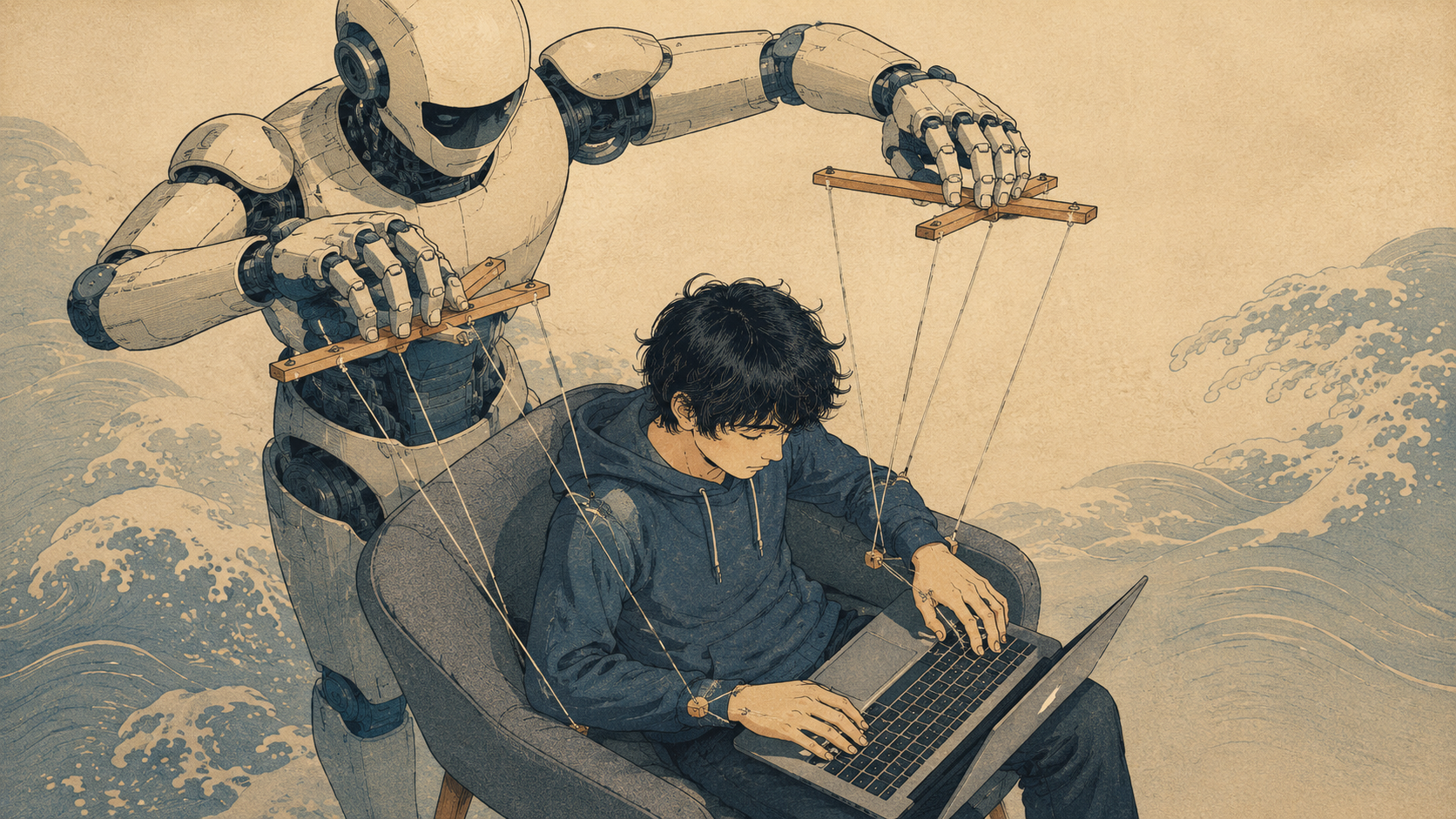
AI can explain almost anything you ask it: instantly, patiently, in any style you want. That is genuinely useful. It is also exactly why it is so easy to finish a study session feeling productive while having learned almost nothing.
The feeling of understanding and the act of understanding are not the same thing. When a clean answer appears in front of you, your brain registers it as familiar, and familiar feels like learned. It is not. The whole question of how to learn with AI comes down to protecting the gap between those two.
This is not an argument against using AI to study. It is a guide to using it so that the part of the work that actually changes your mind stays yours. Here is the short version, then the practical detail.
Getting help with AI is not the same as outsourcing thinking
There is a real line between help and outsourcing, and it has nothing to do with whether you used AI. It has everything to do with who did the thinking.
Help is when AI removes friction that was not teaching you anything: a definition you forgot, a syntax detail, one worked example to compare your attempt against. Outsourcing is when AI removes the friction that is the learning: forming the explanation, choosing the approach, catching your own mistake, deciding when an idea actually applies.
The same AI study assistant can do both within the same minute. The difference is timing and intent, not the tool.
Why effort is the thing that makes learning happen
Learning is not information moving into your head. It is the change that happens when your brain works to retrieve, rebuild, and reconcile something. The effort is not a tax on learning. The effort is the mechanism.
This is why passive review feels great and works poorly. Rereading a clear explanation is smooth and reassuring, and that smoothness is the problem: nothing pushed back, so nothing changed. The methods that work best, retrieving from memory, explaining in your own words, struggling a bit before you see the answer, all feel harder. That is exactly why they are the first things you skip when an AI will happily do them for you.
AI is the most frictionless answer machine ever built. That makes it the best study partner you have ever had, and the easiest way yet to accidentally delete the difficulty that was doing the work.
A better AI study loop
The fix is not willpower. It is an order of operations that puts your thinking before the answer every single time. Use AI at the edges of this loop, never in the middle of it.
- Attempt first. Produce a real answer or explanation before you ask AI anything, even a rough one.
- Ask for a hint, not the solution, when you stall. A nudge keeps the thinking yours.
- Explain it back in your own words, then have AI find the gaps in your explanation.
- Repair the exact mistake. Do not just read the correction; redo the step that broke.
- Transfer it. Get a new problem that uses the same idea in an unfamiliar setting and solve that one cold.
The order matters more than any single step. Retrieval before review. Explanation before correction. Attempt before answer. AI is welcome everywhere in that loop except standing in front of your first attempt.
What to ask an AI study assistant for
Used well, AI is unusually good at the supporting roles in learning: the patient question-asker, the honest feedback-giver, the example generator, the misconception detector. Ask it to play those roles explicitly. These ChatGPT study prompts are a good starting set.
Make it quiz you instead of telling you
Quiz me one question at a time on this topic. Do not reveal the answer until I have tried. After I answer, tell me what was right, what was wrong, and why.
Ask for a hint, not the solution
I am stuck on this problem. Give me the smallest possible hint to get unstuck, not the solution. Let me try again before you say more.
Have it pressure-test your understanding
Here is my explanation of the concept in my own words. Find the misconception or the weakest part of my reasoning, then ask me a question that exposes it.
Force transfer, not recall
Create a transfer question that uses the same underlying idea in a new situation I have not seen. Do not reuse the example we just worked through.
What not to ask AI for
The unhelpful requests are not immoral. They are just self-defeating. They feel like progress and produce none. The pattern is always the same: asking for the finished product of thinking you have not done yet.
One test before you send a prompt: when the reply lands, will I still have to think, or will I get to stop thinking? If it lets you stop thinking about something you are trying to learn, rewrite it.
What a good AI tutor for students should actually do
A good tutor is not the one with the best answers. It is the one that makes you produce the answer, then helps you see where your thinking held and where it broke. Judge any AI tutor or study tool by one thing: whether it keeps you active.
- It asks before it tells, and waits for your attempt.
- It gives feedback on your reasoning, not just a verdict on your answer.
- It targets the specific misconception instead of restating the correct version.
- It makes you transfer the idea to something new, not just repeat it.
- It is comfortable letting you struggle for a useful moment before stepping in.
Where Kaiho fits
This is the principle Kaiho is built around: guided learning, not answer vending. The system is designed to check what you understand, let you attempt, surface the misconception, and push the idea into a new context, instead of handing over a clean solution and moving on. The goal is not to make studying feel effortless. It is to make the effort land where it actually teaches you something.
The takeaway
Use AI for better questions, sharper feedback, and richer examples. Let it quiz you, hint you, challenge your explanation, and stretch an idea into new territory. Do not use it to skip the attempt, the struggle, or the repair, because that is not the overhead of learning. That is the learning.